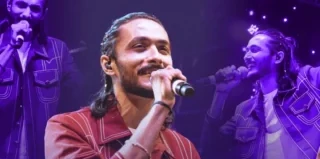
Navratri is the busiest, loudest, most alive stretch of my year. Nine nights, one circle, thousands of feet moving to the same beat. But behind the lights and the energy there is something older and quieter — a form of devotion that has been danced in Gujarat for centuries. This is what those nine nights mean to me.
What Navratri actually celebrates
Navratri means “nine nights.” It honours the goddess Amba — Shakti, the divine feminine — and her victory over darkness. Each night carries its own colour, its own mood, and its own prayer. It is a festival of faith first, and a festival of dance second. The two are impossible to separate.
The nine nights
Traditionally, the nine nights are devoted to nine forms of the goddess. In practice, for those of us on stage, they become a rhythm: the crowd grows a little bigger each night, the dancers a little more fearless, until the final night feels less like a performance and more like a wave everyone is riding together.
Why we dance in a circle
The garba circle is not an accident. Dancers move around a centre — often an earthen lamp, the garbo, or an image of the goddess. The lamp represents the divine light that never goes out. We circle it the way the earth circles the sun: endlessly, in devotion, never quite arriving, never wanting to.
When you are singing from the stage and you watch that circle turn for hours, you understand something words cannot hold. Nobody is the star. Everybody is part of the same turning.
Garba and Raas: the difference
People often use the two words as if they mean the same thing. They don’t, quite.
Garba
Garba is danced with the hands and claps, usually in a circle, often devotional in its lyrics. It builds slowly and can go on for a very long time.
Raas (Dandiya Raas)
Raas is danced with sticks — the dandiya — in pairs, and it is faster, more playful, more percussive. If garba is the prayer, raas is the celebration that follows it.
What a Garba night feels like from the stage
Sound check ends, the lights drop, and for a moment there is complete silence. Then the harmonium breathes in, the dhol answers, and the floor fills. From up there, a good Garba night has a physical shape — you can feel the tempo pulling the room, and your job as a singer is to hold that tempo like a thread without ever letting it snap.
The hardest and most beautiful part is stamina. A real Garba night does not end because the songs run out. It ends because the sun is coming up.
The songs that carry the night
Some songs belong to Navratri the way certain smells belong to a kitchen. Aartis to open the evening, traditional garba to warm the circle, non-stop medleys to keep it turning, and a slow, devotional close when everyone is tired and grateful. Sequencing those songs well is its own quiet craft.
Frequently asked questions
What is the meaning of Navratri?
Navratri means “nine nights.” It is a Hindu festival honouring the goddess Durga or Amba in her nine forms, celebrating the triumph of good over evil. In Gujarat it is marked with nightly garba and raas.
What is the difference between garba and dandiya raas?
Garba is danced with claps and hand movements in a circle around a central lamp, and is more devotional. Dandiya raas is danced with sticks in pairs and is faster and more playful.
Why do people dance around a lamp during garba?
The central lamp, or garbo, symbolises the divine light of the goddess. Dancing in a circle around it is an act of devotion — a reminder that the light at the centre is what everything turns around.
How long does a traditional Garba night last?
A traditional community Garba night can last from a few hours to all night, sometimes ending only at sunrise. During Navratri this happens for nine consecutive nights.
Leave a Reply